


Following the Money: A Financial Ethnography of Education Costs in Rural Cambodia
Project Date
???
Theme
Development Impact
The Challenge
UNICEF and Cambodia's Ministry of Education launched scholarships for ethnic minority students in the remote northeast—but no one had verified whether the programme was working. Were the most disadvantaged students being selected? Were scholarships delivered on time? Were funds used effectively?
The Mission
Look beyond enrollment statistics to map the complete financial landscape of secondary education for ethnic minority families and identify whether scholarships were closing the gap. The goal: provide actionable recommendations grounded in authentic participant voices.
Our Approach
Our methodology positioned students as expert informants on household economics, a natural fit for boarding students who manage their own money.
-
-
-
-
- Financial Ethnography · We asked students to systematically list and price every item needed for school, from uniforms, transportation, meals to other additional expenses.
- Deep Fieldwork: Moderated 12 student focus groups with 94 participants across ethnic minority and non-minority backgrounds, male and female students and conducted 31 interviews with government officials and representatives from development partners, donors, and schools at national, provincial, and district levels
- Observational data · Conducted 17 home visits and dormitory tours to understand living conditions and hidden costs, adding a crucial layer of context missed by paperwork.
- Cultural Sensitivity · Collaborated with a bilingual research team to ensure cultural nuance and precision in capturing costs and struggles that would otherwise be lost in translation.
-
-
-
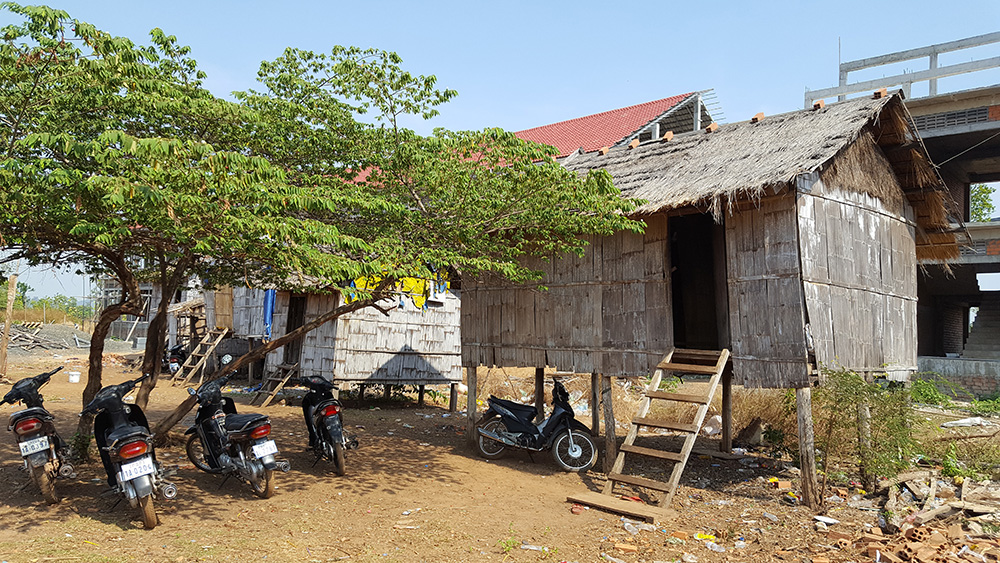
Dormitory on school premises shared by four students, one of whom is a scholarship recipient, Preah Vihear province. Photo credit: Monica Biradavolu, 2018
Key insights
1. Reaching the Disadvantaged · The Necessity of Home Visits
Were the Most Disadvantaged Students Being Selected?
Largely yes—but the true main evidence came from sitting in people's homes, not from paperwork.
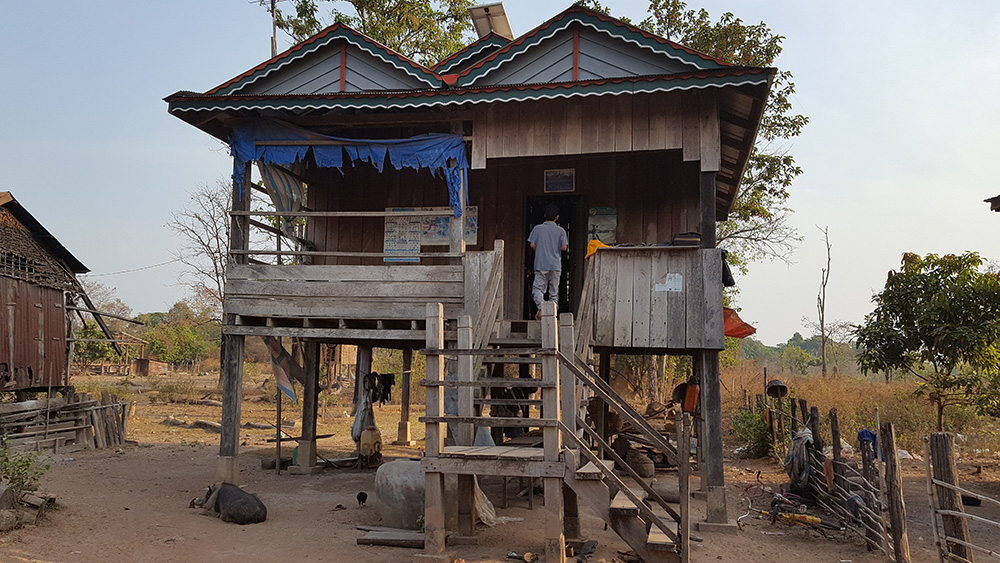
Our team visited 17 households across three provinces. Fourteen families were living in visibly difficult circumstances, demonstrating the program was indeed reaching the deeply poor.
In a village in Ratanakiri, we climbed unstable wooden steps to meet a father, a cassava farmer, whose own parents had died when he was six. Mid-conversation, he abruptly stepped away. He said something was bothering his eye,but it soon became clear. His eyes had welled up with tears— he couldn't meet our gaze. The source of the shame was his inability to provide:
Talking about money is difficult because I cannot earn enough to support my daughters to study. Compared to other families I am very poor...Without the scholarship, it is very difficult because I have to borrow money from my neighbours.
Yet his pride in his daughter was unmistakable:
My daughter is a good student. She was fourth in her class...She works hard to fulfill my dreams because she sees us in difficult circumstances.
The programme was reaching families like this.However, with inadequate monitoring budgets and 67% of recipients being first-time scholarship holders, questions remained about whether the most disadvantaged were consistently being prioritized over simply those who happened to be ethnic minority and enrolled.
The Discovery
Home visits revealed what paperwork couldn't: the depth of family poverty and the critical role scholarships played in preventing dropout.
2. The Penalty of Delay · Bureaucracy vs. Need
Were Scholarships Reaching Students on Time?
No. The school year begins in November, but when the research team visited in late March, students had just received a partial payment—meaning the funds were already two months late.
The Cause: Administrative Caution
The delays stemmed from a combination of bureaucratic caution and fiscal year misalignment:
-
- Schools delayed payment until after enrollment to avoid including dropouts.
- Paperwork crawled through multiple approval layers.
- The Ministry's fiscal year (January–December) did not match the school year (November–August), compounding the problem.
After one focus group ended, a female student lingered at the door. When we asked what she wanted, she hesitantly stepped back inside:
Can you please tell the Ministry to send the scholarship money? I need the money.
The Cost: Penalizing the Motivated
The system prioritized administrative convenience, penalizing the vast majority of students. With dropout rates among scholarship recipients at only 2.7%, the system delayed vital funds for months for the 97.3% of motivated students just to avoid the minor administrative hassle associated with a tiny minority.
The Discovery
The key discovery was that payment delays weren't just procedural—they directly impacted the survival of motivated, financially fragile students, as shown by the girl quietly pleading for her overdue scholarship money.
3. The Shadow System · Mandatory Paid Classes
Were Students Using Scholarship Funds Appropriately, and Were the Amounts Adequate? The answer is yes to the first question, but a resounding no to the secondStudents were using funds as intended,but the scholarship covered only a fraction of true schooling costs.
-
- The System Revealed: Financial Ethnography
The research team treated students as financial experts, who had no trouble calculating costs, especially those managing their own money while boarding. This exercise revealed that students themselves controlled the scholarship funds.
- The System Revealed: Financial Ethnography
The investigation exposed a structured, fee-based system hidden within the public schools, known locally as Rean Kour (Mandatory Paid Classes). Parents and administrators confirmed this: these are the same teachers teaching the same subjects for a fee because the full curriculum is withheld during regular school hours.
- The Financial Barrier: Inadequate Funding
The financial ethnography documented the precise costs, revealing a mandatory, unacknowledged barrier:
-
-
- Universal Annual Expenses: The three universal categories were: Clothing ($74/year), School Supplies ($64/year), and Mandatory Extra Classes.
- The Hidden Cost: Most students take three extra classes, totaling ∼$153 per year ($48−$59 per subject).
- Universal Annual Expenses: The three universal categories were: Clothing ($74/year), School Supplies ($64/year), and Mandatory Extra Classes.
-
This mandatory system created a massive financial gap:
| Annual Cost Component | Cost per Year |
|---|---|
| Total True Basic Cost (Supplies + Clothing + Rean Kour) |
∼$291 |
| Scholarship Amount Received | ∼$150 |
| Financial Gap | ∼$141 |
This gap widens into a chasm for students with additional expenses like motorcycle commuting ($136/year for gas and parking) or paying for room and board ($633/year).
4. The Human Toll · The Agonizing Choice
The issue of extra classes became an implicit poverty indicator—students were embarrassed to admit they couldn't afford them. The interviews captured the devastating reality students faced:
One teacher described the agonizing choice:
Some decide to take extra classes and not eat. They will give up their food so that they can pay. Some give up extra classes so that they can eat.
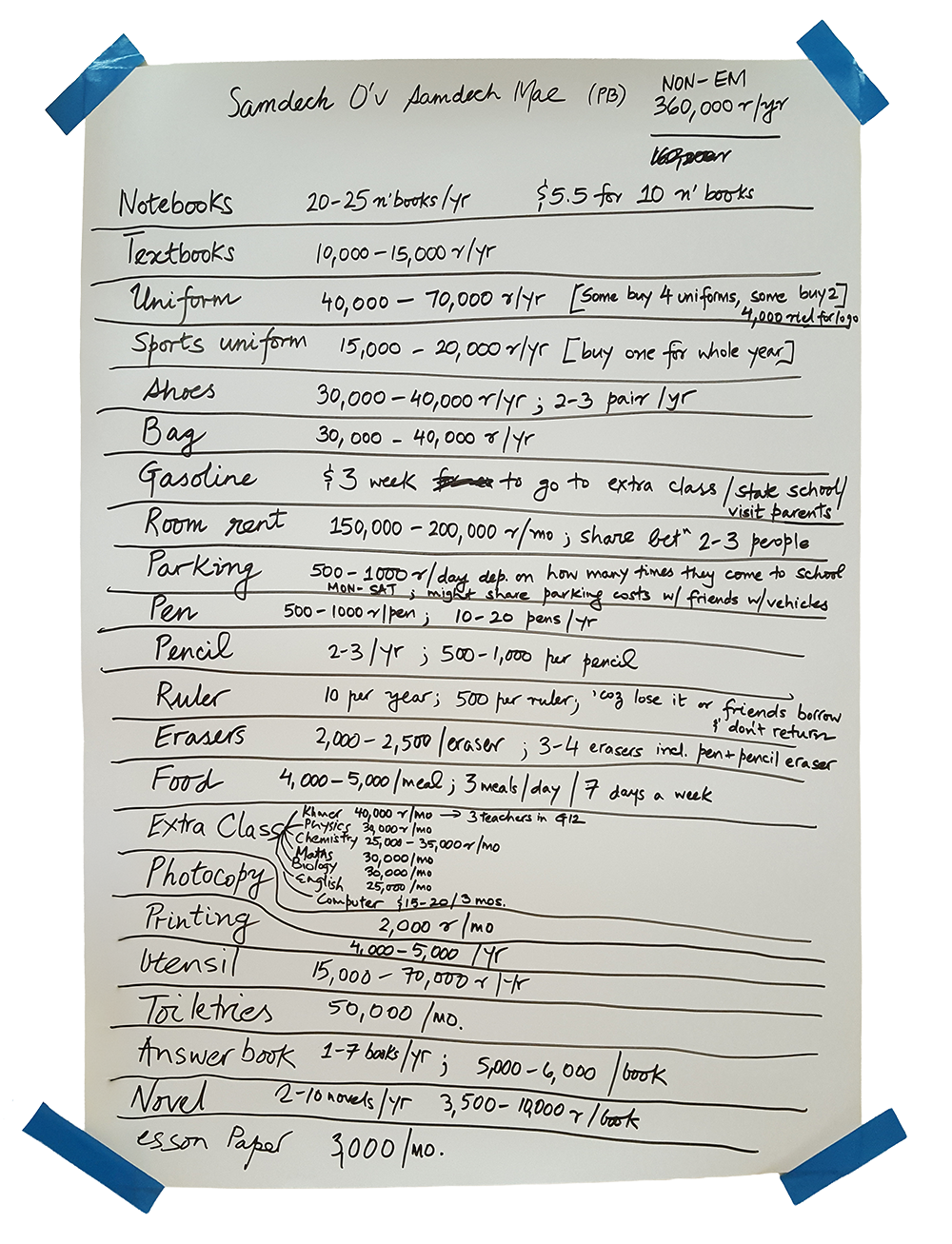
A chart completed in a focus group with a free listing of categories on which students spend money annually, and associated costs. Photo credit: Elizabeth Fisher, 2018
The Discovery
By treating students as financial experts, we documented what everyone knew but no one acknowledged—a shadow education system of mandatory paid classes that made 'free' schooling expensive and rendered the $150 scholarship amount inadequate.
The Impact · Reshaping Policy and Funding
The research produced evidence-based recommendations that reshaped policy discussions on scholarship design between UNICEF and Cambodia's Ministry of Education:
-
-
- Fix the timing gap: Restructure payment schedules to deliver funds at the start of the school year, acknowledging the student's immediate need.
- Account for hidden costs: Increase scholarship amounts to $300 to cover the shadow education system of mandatory extra classes
- Recognize student agency: Create direct student bank accounts, acknowledging that boarding students already manage their own money.
- Celebrate parental sacrifice: Organize community events to recognize parents who keep their children in school, potentially motivating others in the same communities.
-
The findings were validated in a workshop with ministry officials and development partners, and informed subsequent scholarship design discussions across the Education Sector Working Group.
The Breakthrough
The breakthrough came when students itemized their actual school costs. Their meticulous accounting—down to pencils and weekly gas—revealed what program designers had missed: mandatory "Rean Kour" (extra classes) taught by the same teachers added $153/year to "free" education. This fee exposed the core contradiction: the $150 scholarships were insufficient to cover even the mandatory costs. Students choosing between lunch and extra classes weren't exaggerating—they were making rational trade-offs in a system where teachers withheld curriculum during regular, paid hours to sell it during paid extra sessions.
Publication
To be included.
The Team & their Contribution
Monica Biradavolu
Principal Investigator, QualAnalytics
Key Contribution
Designed and led the qualitative research, worked with a translator for data collection, analyzed the qualitative data, and wrote up the qualitative findings with actionable recommendations.

Manich
Translator
Key Contribution
Translator for interviews and focus group discussion sessions.
Elizabeth Fisher
Intern, UNICEF Cambodia
Key Contribution
Note-taker
Partners and Funders
This work was made possible through collaboration with leading institutions
Funded By